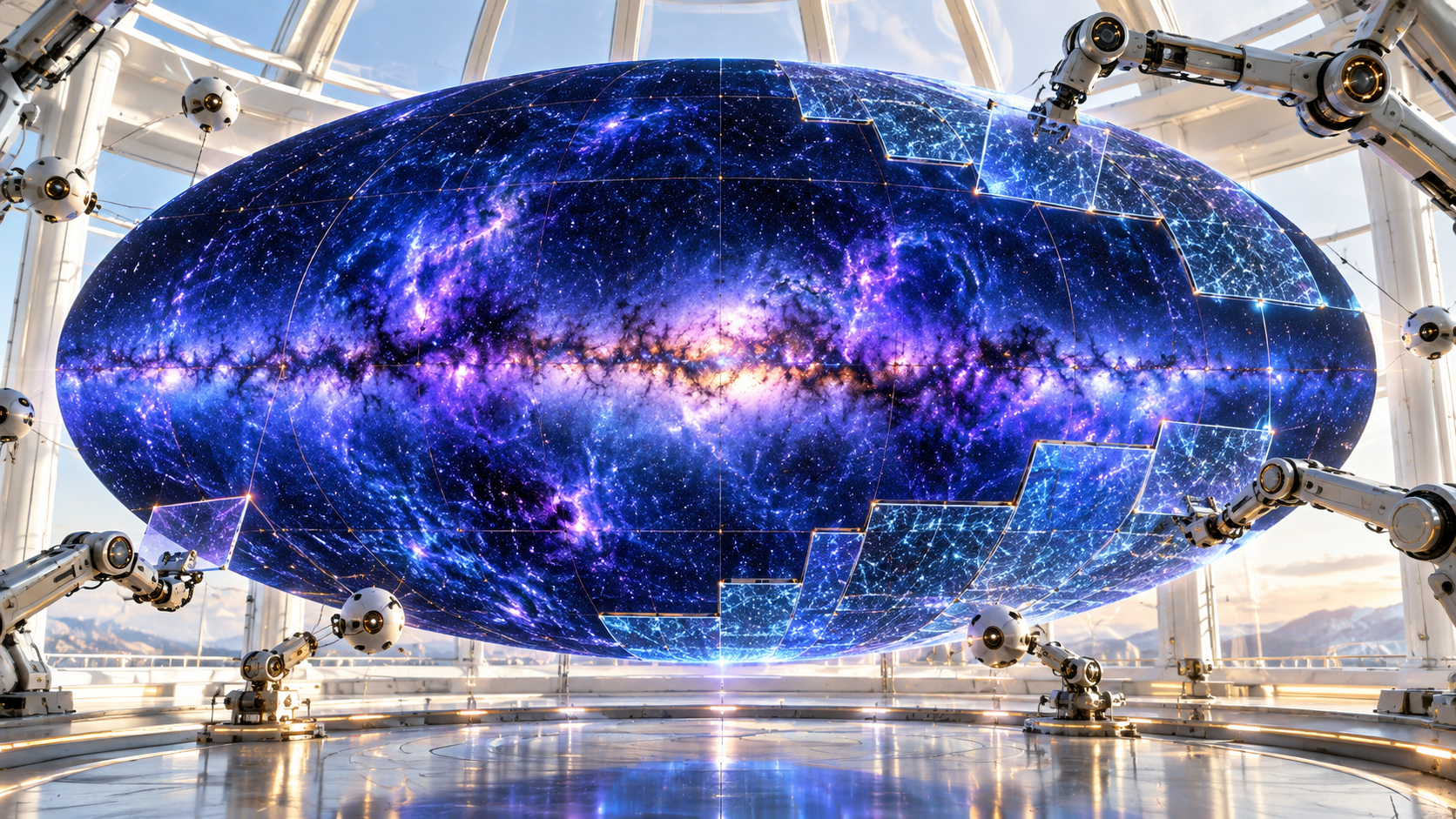
Claude Science helped create the first complete ultraviolet map of the sky
Claude-orchestrated agents combined decades of space-telescope data and filled unobserved regions with provenance and uncertainty labels.
AT A GLANCE
Key points
- The project produced the first complete ultraviolet map of the sky
- Roughly one third of the map was statistically estimated
- More than 100 million Gaia stars were added
- Human review caught artifacts that agent reviews missed
What is changing?
Brice Ménard, an Anthropic researcher and Johns Hopkins University astrophysicist, said he used Claude Science to create the first complete ultraviolet map of the sky. The project combined open datasets from GALEX, Swift, FIMS/SPEAR, and other sources on a shared scale, resolution, and coordinate system.
Claude-orchestrated agents cleaned tens of thousands of images, performed cross-calibration, and estimated roughly the third of the sky never directly observed in ultraviolet using a statistical method trained on visible, infrared, and radio measurements. Hidden-data tests brought estimates to within about 10% of real measurements, and UV estimates for more than 100 million Gaia stars were added.
The process was not fully autonomous. Ménard noticed circular artifacts left by atmospheric glow in 38,000 GALEX observations; Claude traced and reprocessed the issue. The human-agent collaboration produced more than a dozen versions over several days.
The published map labels whether each pixel was measured or predicted and provides uncertainty estimates. Its technical page stresses that filled regions cannot be used to discover new stars or galaxies and that the work has not yet undergone human peer review.
Explore the original sources
Source date: 8 October 2026.
Published by AI Radar: 9 Oct 2026, 17:59 (Istanbul, UTC+3).
FOLLOW THE TOPIC
Topics and tags
Share your discovery.
Send this story to a friend.
Reader comments
What do you think about this development? Share your experience or question. Comments are published after editorial approval.
Your name/nickname and comment become public if approved. Read: Privacy notice.



Loading comments…