
Astrolab’s FLIP rover will test LLMs and AI workloads on the Moon
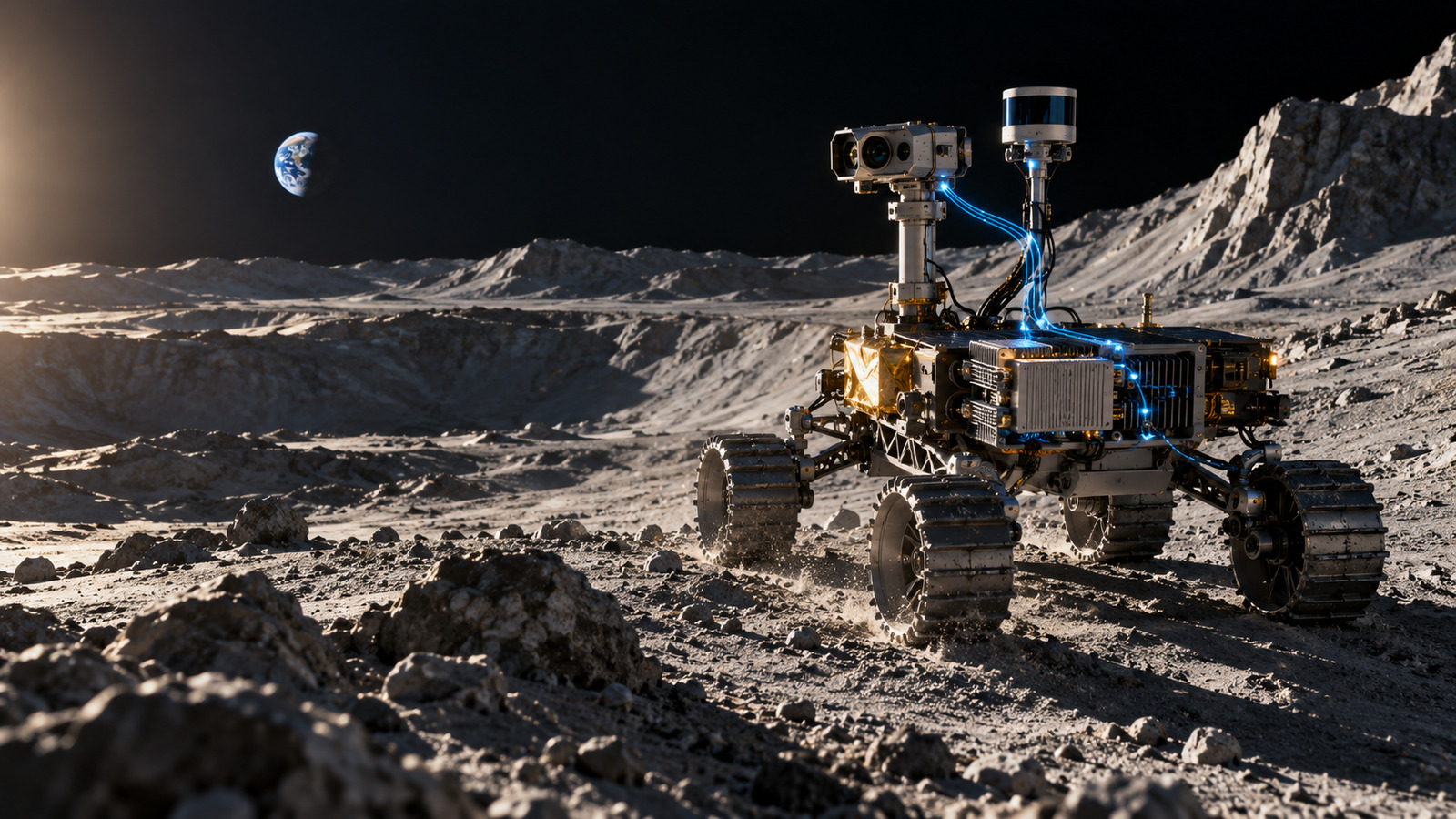
HPE Spaceborne Computer-4 is scheduled to travel to the lunar south pole aboard Astrolab’s FLIP rover in a late-2026 mission, running LLM, vision-inference, LiDAR-processing and HPC tests.
AT A GLANCE
Key points
- The mission is intended to launch in late 2026
- Spaceborne Computer-4 combines a low-power CPU and GPU
- Planned workloads include LLMs, vision inference, LiDAR and HPC benchmarks
- NASA plans a tuned LLM test and the three-model FLUID experiment
What is changing?
HPE announced on October 20 that its lightweight, fanless Spaceborne Computer-4 module will deploy on Astrolab’s FLIP rover. The Griffin-1 mission is intended to launch in late 2026 under NASA’s Commercial Lunar Payload Services initiative and operate near the Moon’s south pole.
The mission is scheduled to test large-language-model document search and interpretation, vision inference, LiDAR mapping and navigation, and high-performance-computing benchmarks on the lunar surface. HPE says the CPU-and-GPU module is intended to process data locally, reduce the amount sent back to Earth, and lessen dependence on delayed communications.
NASA also plans to run the FLUID experiment, coordinating three models trained on data from Earth, the Moon, and the International Space Station, plus a tuned LLM test. These are planned experiments rather than demonstrated lunar production results; the mission still needs to prove reliability under radiation, temperature swings, and constrained connectivity.
Explore the original sources
Source date: 20 October 2026.
Published by AI Radar: 21 Oct 2026, 09:14 (Istanbul, UTC+3).
FOLLOW THE TOPIC
Topics and tags
Share your discovery.
Send this story to a friend.
Reader comments
What do you think about this development? Share your experience or question. Comments are published after editorial approval.
Your name/nickname and comment become public if approved. Read: Privacy notice.






Loading comments…