
AGIBOT opens a physical reasoning dataset to teach robots what to do next
The fourth AGIBOT WORLD 2026 release gives researchers physical reasoning data for reaching the same goal under changing scene conditions and task histories.
AT A GLANCE
Key points
- Release 4 shifts the emphasis from difficult manipulation to difficult decisions.
- The same goal is recorded across changing object counts, obstructions, space and task progress.
- Nine reasoning abilities span selection, prerequisites, search, state tracking, planning and memory.
- AGIBOT says the data supports an upcoming agent framework and foundation model.
What is changing?
AGIBOT announced Physical Reasoning, the fourth AGIBOT WORLD 2026 data release, on October 22. Rather than focusing only on imitating difficult motions, the release centers on reading the current state and selecting the correct next subtask.
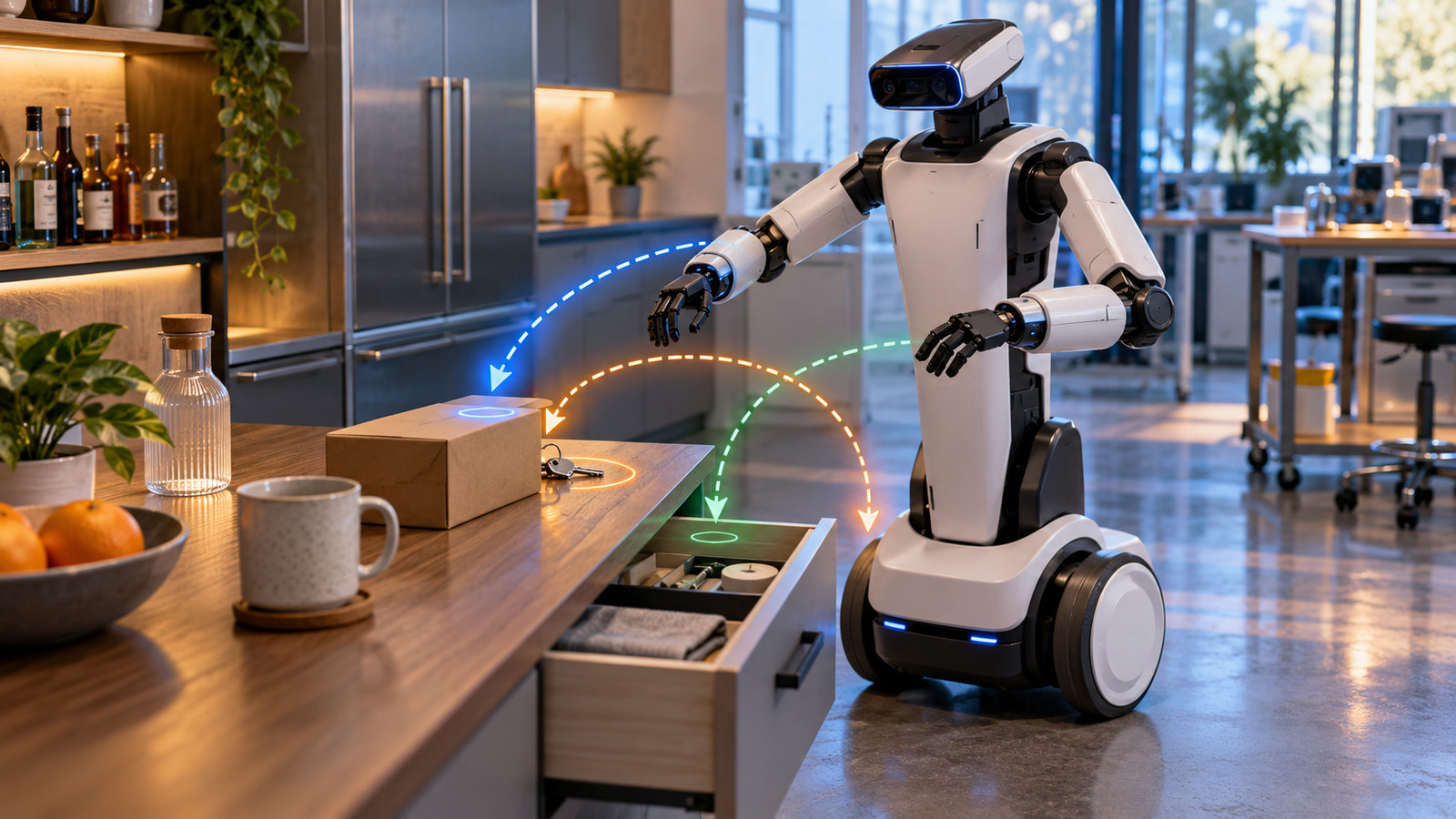
The same goal is recorded across different decision branches by varying object counts, obstructions, available space and task progress. Examples such as restocking a minibar to a target count, reaching a key behind an obstacle and remembering which drawers were already searched require counting, prerequisite reasoning and memory.
The dataset organizes nine reasoning abilities into Easy, Medium and Hard levels. High-level task frames and subtasks are paired with low-level real-robot trajectories describing the object, manipulation region, arm roles, motion and expected result.
AGIBOT says the data has been used for its upcoming agent framework and next-generation foundation model. The release alone, however, does not show that trained systems will generalize reliably to unseen environments; independent performance results still need separate evaluation.
Explore the original sources
Source date: 22 October 2026.
Published by AI Radar: 23 Oct 2026, 15:01 (Istanbul, UTC+3). Updated: 23 Oct 2026, 16:02.
FOLLOW THE TOPIC
Topics and tags
Share your discovery.
Send this story to a friend.
Reader comments
What do you think about this development? Share your experience or question. Comments are published after editorial approval.
Your name/nickname and comment become public if approved. Read: Privacy notice.





Loading comments…