
Dream-1 controls previously unseen bimanual robots through a public API
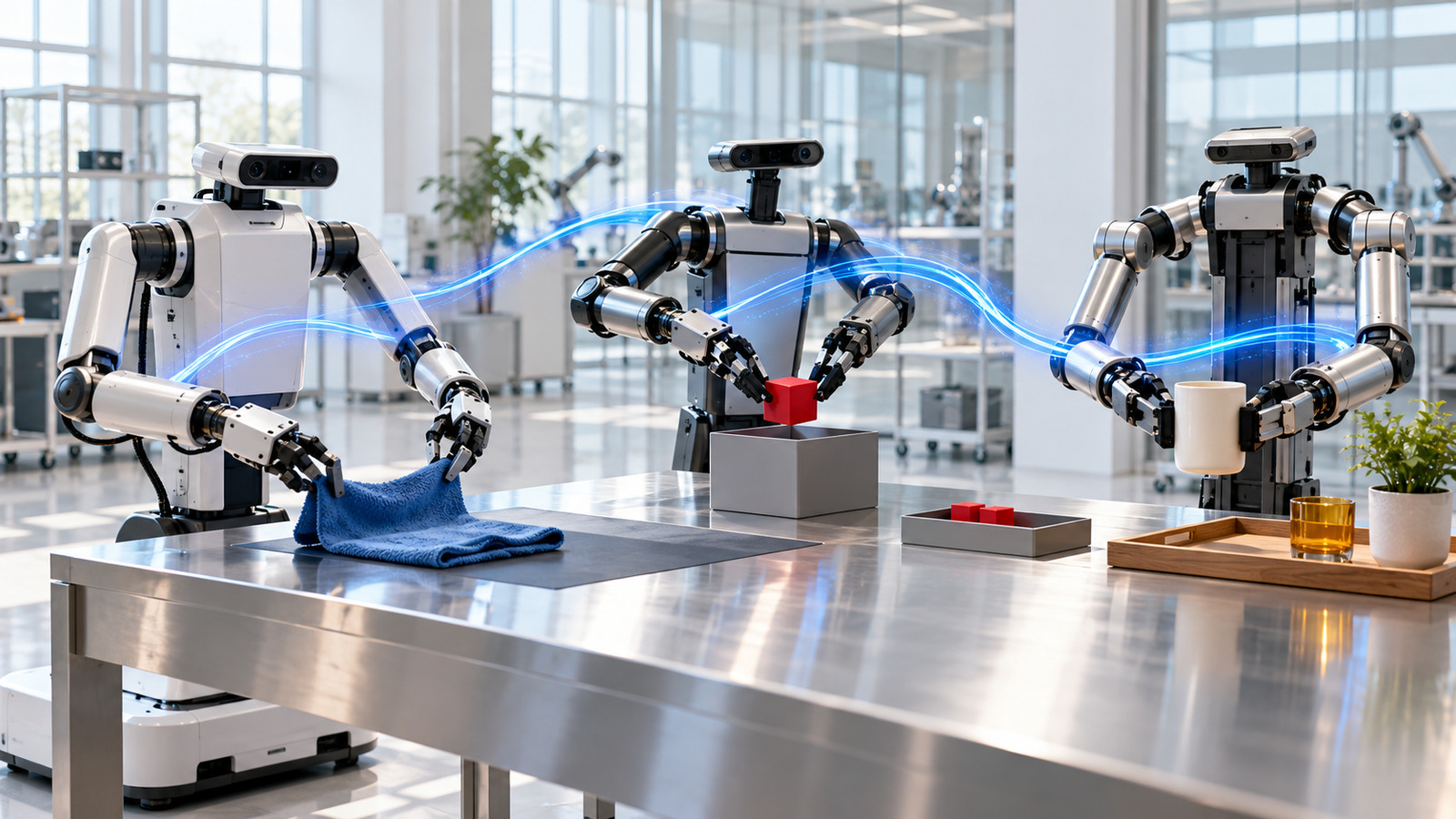
Dream Labs’ World Action Model offers zero-shot transfer to bimanual robots with parallel grippers, plus task-specific adaptation through a public API.
AT A GLANCE
Key points
- Public API for a World Action Model controlling bimanual robots
- Provider reports evaluation on 27 previously unseen robot embodiments
- $3 per hour for Dream-1 and $2 per hour for Dream-1-flash
- Research beta not validated for safety-critical use
What is changing?
Dream Labs released its Dream-1 World Action Model through a public API on October 19. The company says the model can operate bimanual robots and perform tasks it did not see during training without demonstrations from that specific robot. Dream Labs also emerged from stealth with the announcement and disclosed a $90 million seed round.
Rather than being tied only to joint angles, Dream-1 can predict the position and open-or-closed state of the grippers, while each robot’s inverse-kinematics solver turns those targets into motion. The provider says it evaluated the model on 27 unseen robot embodiments. Results can vary with camera placement, workspace and inverse-kinematics quality.
API pricing is $3 per hour for Dream-1 and $2 per hour for the lighter Dream-1-flash. The model remains a research beta and has not been validated for safety-critical use. Where zero-shot transfer is insufficient, Fine-tuning-as-a-Service is intended to build a custom control model from a short recording of the robot’s own data.
Explore the original sources
Source date: 19 October 2026.
Published by AI Radar: 20 Oct 2026, 04:07 (Istanbul, UTC+3).
FOLLOW THE TOPIC
Topics and tags
Share your discovery.
Send this story to a friend.
Reader comments
What do you think about this development? Share your experience or question. Comments are published after editorial approval.
Your name/nickname and comment become public if approved. Read: Privacy notice.




Loading comments…