
OpenAI’s BioBasicsBench evaluates AI agents across 100 routine wet-lab tasks
BioBasicsBench, developed by OpenAI and Ligo, measures whether AI agents can interpret raw experimental data, catch errors, and recognize the limits of evidence across 100 routine wet-lab tasks.
AT A GLANCE
Key points
- BioBasicsBench contains 100 tasks across five areas of routine wet-lab work.
- Seven models were tested across 37 settings for 18,500 attempts.
- At xhigh, GPT‑6 Astra earned 66.7% mean credit versus 43.8% for GPT‑5.6 Sol.
What is changing?
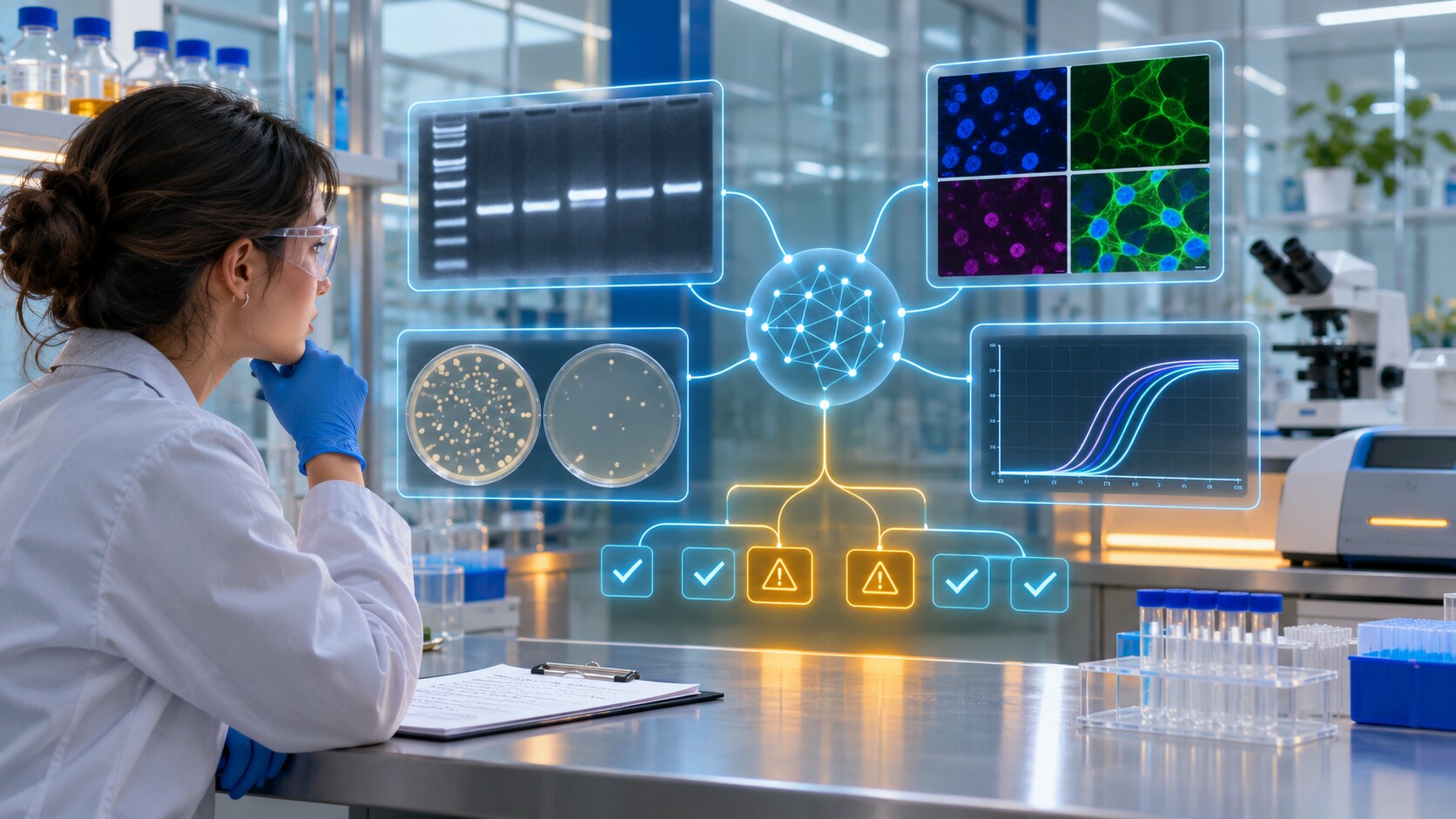
OpenAI has released BioBasicsBench, an evaluation developed with enzyme-design company Ligo. It measures whether AI agents can interpret raw experimental evidence such as gel images, colony plates, microscopy records, sequencing files, and instrument readouts across 100 routine tasks.
The tasks span five areas: protein methods, imaging and cytometry, quantification and assays, nucleic acid methods, and molecular cloning. Agents are scored not only for reaching conclusions, but also for identifying faulty controls, ambiguous images, and cases where the evidence cannot support a conclusion.
OpenAI evaluated seven models across 37 model and reasoning-effort settings, producing 18,500 attempts in total. At xhigh, the highest shared reasoning setting, GPT‑6 Astra received 66.7% mean credit versus 43.8% for GPT‑5.6 Sol. OpenAI says the results show progress while leaving gaps in image interpretation, control checking, and experimental context.
Explore the original sources
Source date: 6 November 2026.
Published by AI Radar: 6 Nov 2026, 23:07 (Istanbul, UTC+3).
FOLLOW THE TOPIC
Topics and tags
Share your discovery.
Send this story to a friend.
Reader comments
What do you think about this development? Share your experience or question. Comments are published after editorial approval.
Your name/nickname and comment become public if approved. Read: Privacy notice.






Loading comments…