
Boston Dynamics uses a wheeled Atlas to test sim-to-real robustness
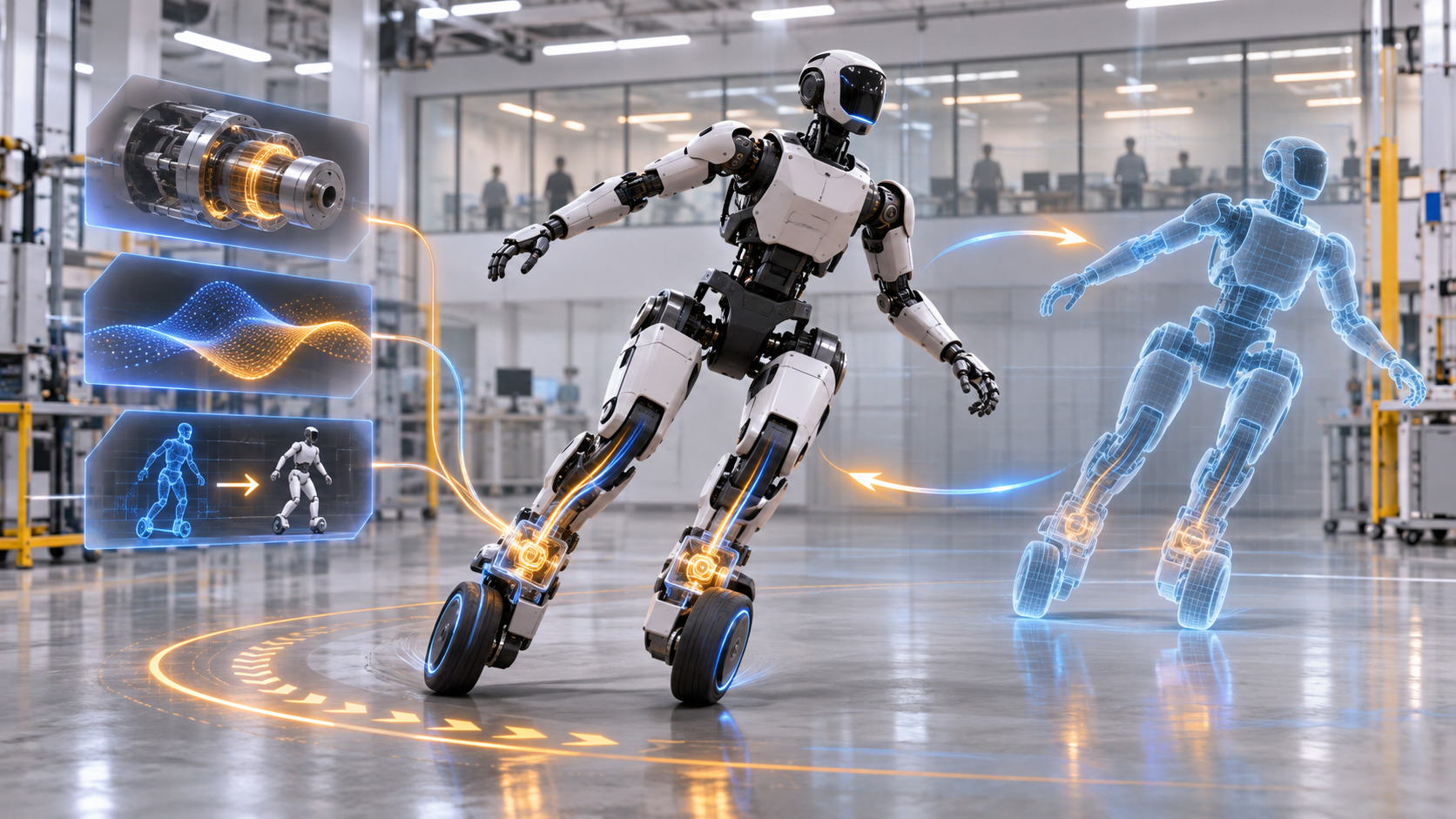
The wheeled Atlas is not a product; it is a research testbed for stressing actuators at high torque and speed and transferring a whole-body reinforcement-learning controller to real hardware.
AT A GLANCE
Key points
- The wheeled Atlas is a research testbed, not a product
- One custom adapter connects an off-the-shelf rim to the ankle actuator
- Lessons will inform robustness against actuator failures
What is changing?
Boston Dynamics replaced Atlas’s feet with wheels to test a whole-body reinforcement-learning controller at the edge of the robot’s actuator envelope. The company explicitly says this is not a new product. The wheels keep the motors operating across high torque and speed during launches, turns, and stops. The conversion used a single custom adapter to attach an off-the-shelf scooter rim to the existing ankle actuator.
In software, each wheel was modeled as an ankle that can rotate continuously. After matching the simulated motor behavior to measured hardware, the policy transferred to the physical robot and learned to use the wheels during moves such as side dashes. The team plans to carry the lessons back to the standard Atlas configuration and to policies that respond more robustly to failed actuators.
Explore the original sources
Source date: 9 November 2026.
Published by AI Radar: 10 Nov 2026, 01:11 (Istanbul, UTC+3).
FOLLOW THE TOPIC
Topics and tags
Share your discovery.
Send this story to a friend.
Reader comments
What do you think about this development? Share your experience or question. Comments are published after editorial approval.
Your name/nickname and comment become public if approved. Read: Privacy notice.






Loading comments…