
RadixArk releases open-weight DaisyRose-27B for long-horizon agent tasks
DaisyRose-27B, based on Qwen3.8-27B, was trained with reinforcement learning for long tool-use and coding tasks; BF16, FP8 and NVFP4 checkpoints are available under Apache 2.0.

AT A GLANCE
Key points
- DaisyRose-27B retains Qwen3.8-27B's architecture, image capability and 256K context.
- BF16, FP8 and NVFP4 checkpoints are available under Apache 2.0.
- RadixArk reports 18 days of training on 144 H200 GPUs using 1,200 long-horizon agent tasks.
- Provider testing raised Terminal-Bench 4.1 pass@1 from 5.6% to 12.0%.
What is changing?
RadixArk released its first model, DaisyRose-27B, on Hugging Face on November 18, 2026. Built on Qwen3.8-27B, it retains the same architecture, tokenizer, chat template, image-understanding capability and 256K-token context window. BF16, FP8 and NVFP4 checkpoints are downloadable under the Apache 2.0 license. The provider recommends SGLang with DSpark speculative decoding and demonstrates an OpenAI-compatible API endpoint. No managed API, pricing or service level was announced.
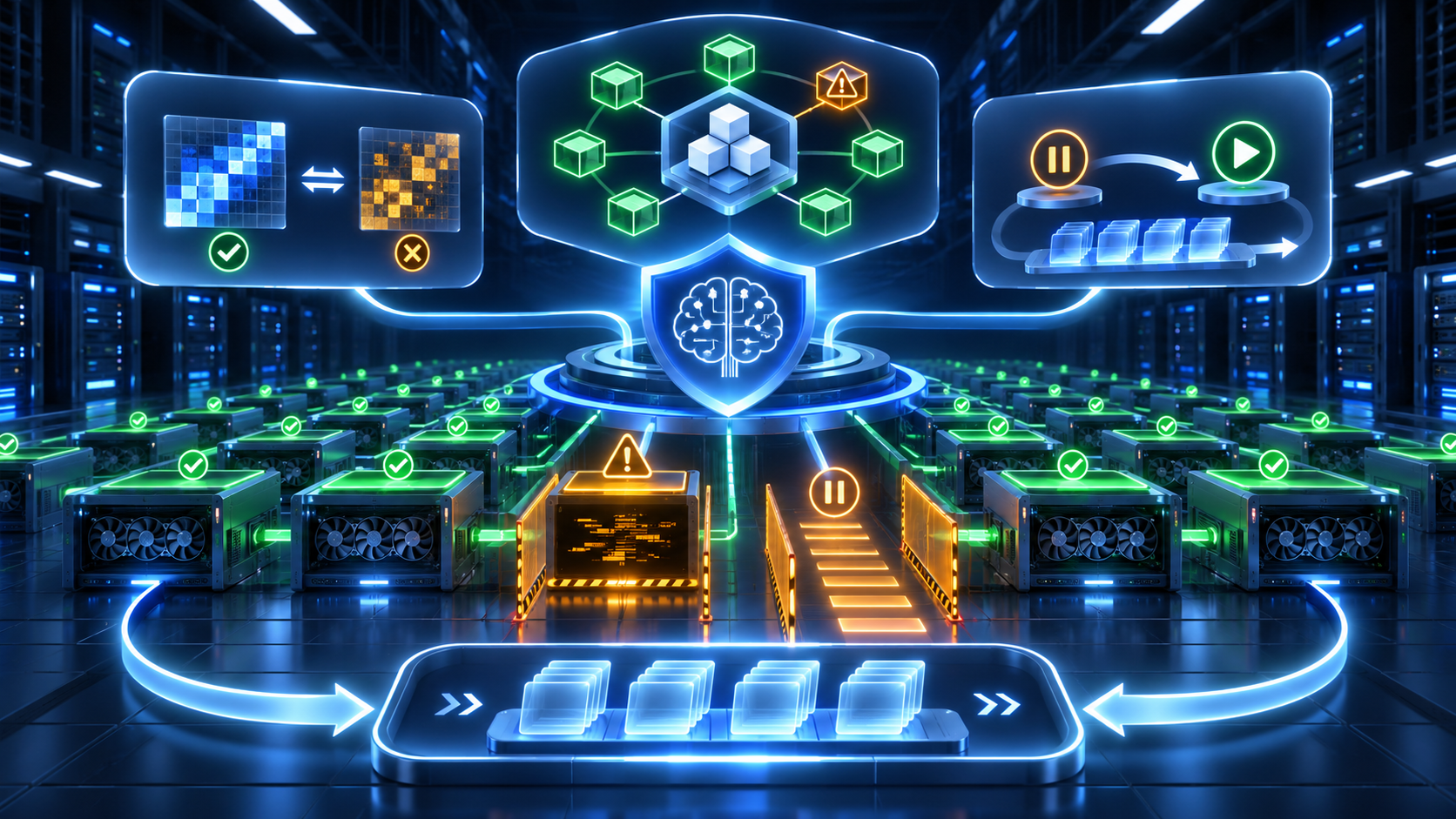
The model was trained with Miles, an open-source reinforcement-learning system, on long-horizon agent sessions that use tools. RadixArk says it used 1,200 curated tasks and that some sessions extended to one million tokens through summarization. Tasks can require multistep reasoning, code editing and more than 100 tool calls. Training ran for 18 days on 144 NVIDIA H200 GPUs: 128 for inference and 16 for the trainer, in a fully asynchronous setup.
In RadixArk's own evaluation, Terminal-Bench 4.1 pass@1 increased from 5.6% for the base model to 12.0% for DaisyRose-27B. The provider also reports gains from 73.0 to 75.5 on Terminal Bench 2.1, 42.2 to 46.2 on DeepSWE, 91.3 to 94.7 on SWE-Bench Pro v2, and 79.5 to 82.4 on IFBench. The table uses the higher result from BF16 and FP8 runs. These are RadixArk's evaluations, not independent comparisons, and run settings can affect the outcome.
For the training system, RadixArk reports 37% model FLOP utilization versus 16% for the open trainer it compared against, end-to-end throughput of 16.8K tokens per second, and 57% less GPU time. It says its sandbox layer handled 944,000 environments over nine weeks, peaked at 1,566 concurrent sandboxes, achieved a 99% success rate, and has exceeded 99.95% since late October. These figures also come from the provider's production records and do not transfer directly to another workload.
This report is prepared with AI assistance and checked against sources. Automated checks do not constitute human editorial review. Editorial approach
Explore the original sources
Source date: 18 November 2026.
Published by AI Radar: 19 Nov 2026, 10:10 (Istanbul, UTC+3).
FOLLOW THE TOPIC
Topics and tags
Share your discovery.
Send this story to a friend.
Reader comments
What do you think about this development? Share your experience or question. Comments are published after editorial approval.
Your name/nickname and comment become public if approved. Read: Privacy notice.




Loading comments…